
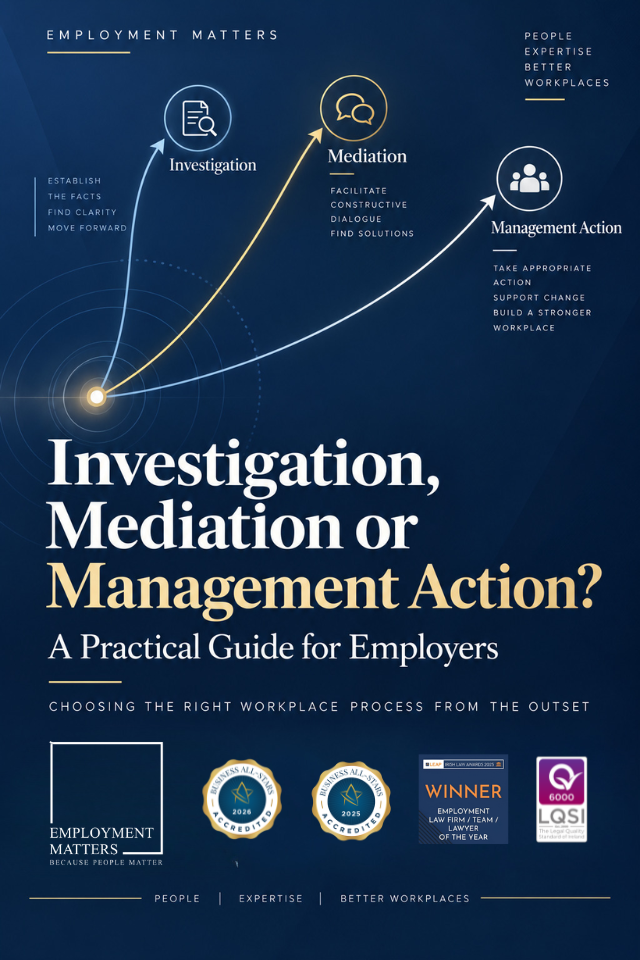
Workplace issues are often made more difficult by starting the wrong process.
A complaint is received and an investigation begins automatically. Two employees are in conflict and the matter is treated as misconduct. Performance concerns continue for months without clear standards being set. A grievance and an existing performance issue are combined into the same process.
For HR and management, the first decision should be to identify what needs to be established or achieved.
Broadly:
- Investigation is appropriate where material facts are disputed and findings are required.
- Mediation is appropriate where the objective is to resolve conflict or restore a workable professional relationship.
- Performance management addresses identifiable shortcomings in standards, capability or output.
- Disciplinary action addresses alleged misconduct.
- Redundancy addresses the requirements of the role or business, rather than employee conduct.
- WRC claim management deals with an existing legal complaint and requires evidence, procedure and litigation risk to be assessed.
These processes can overlap, but they should not be confused.
Getting that distinction right at the outset can reduce delay, procedural risk and unnecessary escalation.
1. When Is a Workplace Investigation Appropriate?
An investigation is primarily a fact-finding process.
It is generally appropriate where the organisation needs to determine whether particular events occurred before deciding what, if anything, should happen next.
Examples include:
- conflicting accounts of an incident;
- allegations of bullying or harassment;
- complaints involving serious misconduct;
- disputed grievances;
- allegations concerning a senior employee or manager;
- complaints involving multiple witnesses or significant documentary evidence; or
- situations where an internal decision-maker cannot reasonably establish the facts without a separate investigation.
A good investigation should begin with a defined scope.
HR should be clear about:
- the allegation or issues being investigated;
- the terms of reference;
- the applicable workplace policy;
- the evidence likely to be relevant;
- the witnesses who may need to participate;
- how the person complained about will be given an opportunity to respond;
- the standard against which findings will be made; and
- what the investigator is — and is not — being asked to decide.
One of the most common process problems is allowing an investigation to drift into disciplinary decision-making.
The investigator’s role will generally be to establish relevant facts and make findings within the agreed terms of reference. Whether disciplinary action follows should ordinarily be considered separately under the organisation’s disciplinary procedure.
HR point
Before appointing an investigator, ask:
Do we genuinely need findings of fact before management can decide what happens next?
If the answer is no, an investigation may add unnecessary formality, delay and cost.
2. When Should an Investigation Be Independent?
Not every investigation needs an external investigator.
Many routine workplace matters can be investigated appropriately by a suitably experienced internal manager or HR professional.
External independence becomes more important where there is a credible concern about impartiality or the complexity of the process.
That can include cases where:
- the complaint concerns senior management;
- members of HR are witnesses to relevant events;
- the obvious internal investigator reports to a person involved in the complaint;
- the allegations are particularly serious or sensitive;
- there has already been substantial internal conflict;
- several previous processes have taken place;
- the volume of evidence is significant; or
- confidence in an internal investigation is likely to be challenged.
The decision should not simply be based on the seniority of the people involved.
The practical question is whether the organisation has someone internally who can conduct the process competently, fairly and with sufficient independence.
If not, external fact-finding may be appropriate.
3. When Is Mediation the Better Process?
Mediation serves a different purpose.
It is not a mechanism for deciding whose version of events is correct.
A workplace mediator facilitates a confidential and structured discussion between participants with the objective of identifying whether an agreed way forward is possible.
It can be particularly effective where:
- working relationships have deteriorated;
- communication has broken down;
- colleagues must continue working together;
- there has been a grievance but the core issue is relational;
- disagreements between managers and employees are becoming entrenched;
- a team conflict is beginning to affect the wider workplace; or
- both parties are willing to participate in a resolution process.
The distinction for HR is important.
If the organisation needs a definitive finding on whether serious misconduct occurred, mediation may not address that requirement.
If the facts are largely understood and the real problem is that two people can no longer communicate effectively, a full investigation may do little to repair the working relationship.
A useful test
Ask what the organisation needs at the end of the process.
If the required output is:
“We need findings about what happened”
consider investigation.
If the required output is:
“We need to establish whether these people can agree a workable way forward”
consider mediation.
4. When Is the Issue Performance Management?
Performance problems are sometimes allowed to develop into disciplinary disputes because the underlying concern was never properly defined.
Performance management should focus on identifiable standards.
HR should be able to articulate:
- what standard is required;
- where current performance falls short;
- what evidence supports that assessment;
- what feedback has already been provided;
- whether training or support is required;
- what improvement is expected;
- the timeframe for improvement; and
- how progress will be measured.
Terms such as “poor attitude”, “not performing”, “not a good fit” or “not meeting expectations” are rarely sufficient by themselves.
The employee needs to understand what is wrong and what improvement looks like.
For example, instead of:
Performance needs to improve.
the process should be capable of identifying matters such as:
- recurring errors in particular work;
- missed agreed deadlines;
- failure to meet defined output;
- specific quality issues;
- repeated failure to follow an established procedure; or
- identified capability gaps.
Performance management becomes much easier to administer fairly when concerns are specific, measurable and documented.
5. Do Not Automatically Convert Performance Into Misconduct
Performance and misconduct are not interchangeable.
An employee who cannot meet a required standard may present a capability or performance issue.
An employee who is capable of complying with a clear instruction but deliberately refuses to do so may present a conduct issue.
The distinction can affect:
- the procedure used;
- the support offered;
- the warnings issued;
- the evidence required; and
- the proportionality of any eventual sanction.
Before moving from performance management into discipline, HR should be clear about what has changed in the nature of the issue.
Using disciplinary language simply because a performance process has become frustrating can create avoidable risk.
6. When Redundancy Is Being Considered, Keep the Business Rationale Separate
Redundancy is fundamentally about the employer’s requirements for the role or work.
It should not be used to resolve:
- performance concerns;
- personality conflict;
- misconduct;
- grievances; or
- difficult working relationships.
Where redundancy is genuinely under consideration, HR should be able to identify:
- the business rationale;
- the role or work affected;
- whether a selection process is necessary;
- the proposed selection criteria;
- who is potentially affected;
- what consultation will take place;
- what alternatives may exist; and
- what records support the proposal.
Problems frequently arise where a performance issue, grievance or conflict already exists and redundancy is subsequently proposed.
That does not necessarily make the redundancy invalid.
It does mean the employer should be particularly careful to demonstrate that the redundancy has an independent business basis and is not being used as an alternative way of addressing another employment issue.
7. What Changes When a WRC Claim Has Already Arrived?
Once a WRC complaint has been made, the organisation is no longer only managing an internal HR issue.
It is also managing a legal claim.
The immediate priority should be a structured assessment of:
- the statutory complaints made;
- relevant limitation dates and procedural deadlines;
- the employee’s factual allegations;
- the employer’s response;
- the contemporaneous documentation;
- the procedure followed internally;
- relevant witnesses;
- potential weaknesses;
- possible financial exposure; and
- whether defence, negotiation or resolution is appropriate.
A common mistake is to begin drafting the employer’s formal position before testing the evidence internally.
HR should first establish whether the documents and witnesses actually support the explanation the organisation intends to give.
The WRC hearing should not be the first occasion on which weaknesses in the employer’s process are identified.
8. One Workplace Problem May Require More Than One Process
Complex cases rarely fit neatly into one category.
For example, an employee may:
- make a grievance against their manager;
- already be subject to a performance process;
- subsequently go on sick leave;
- raise a protected disclosure; and
- later submit a WRC complaint.
Those matters should not simply be combined into one process because they involve the same employee.
HR may need to maintain separate tracks.
For example:
Grievance / allegations
May require investigation.
Performance issue
May continue through a separate performance-management process, subject to the circumstances.
Relationship breakdown
May potentially be suitable for mediation.
Protected disclosure
Requires consideration under the appropriate protected-disclosures procedure.
WRC claim
Requires claim assessment and defence strategy.
The critical issue is governance.
Who owns each process?
What information can properly be shared between them?
Are any decision-makers conflicted?
Could the outcome of one process improperly influence another?
Are employees clear about which meeting or process they are participating in?
Good process management is often less about launching another procedure and more about keeping existing procedures properly separated.
9. Five Questions HR Should Ask Before Starting Any Formal Process
Before deciding what process to initiate, ask:
1. What decision does the organisation actually need to make?
If facts need to be established, investigate.
If the issue is future working relationships, consider mediation.
If standards need to improve, manage performance.
2. Are material facts genuinely disputed?
Do not commission a substantial investigation simply to confirm matters that everybody already accepts.
Equally, do not try to mediate a factual dispute where the organisation genuinely needs findings before it can act.
3. Is the proposed decision-maker sufficiently independent?
Consider whether anybody involved in investigating, deciding or hearing an appeal has already been substantially involved in the events.
4. Are multiple processes affecting the same employee?
Identify where separation is required and make the purpose of each process clear.
5. What evidence will the organisation need if the decision is challenged six months from now?
Think about documentation at the beginning, not at the WRC hearing.
10. A Simple HR Decision Framework
A useful starting point is:
Facts disputed?
→ Consider Investigation
Relationship breakdown, but facts broadly understood?
→ Consider Mediation
Employee not meeting defined standards?
→ Consider Performance Management
Alleged misconduct?
→ Consider Disciplinary Procedure, with investigation where required
Role or work genuinely reducing or disappearing?
→ Consider Redundancy Process
Formal employment claim received?
→ Move to Claim Assessment and Defence Strategy
The circumstances may require more than one process.
But each should have a defined purpose.
Why Process Selection Matters
Using the wrong process can create practical problems even where management’s underlying concern is legitimate.
For example:
- an unnecessary investigation may entrench workplace conflict;
- mediation may fail where formal factual findings are required;
- disciplinary action may be inappropriate for a capability issue;
- performance management may be used incorrectly to address misconduct;
- redundancy may be undermined if it appears to be addressing an employee problem rather than a genuine role requirement; and
- overlapping processes may create allegations of bias, retaliation or predetermined outcomes.
For HR professionals, process selection is therefore not an administrative step.
It is part of risk management.
How Employment Matters Supports Employers
Employment Matters provides separate services for:
- Independent Workplace Investigations;
- Workplace Mediation;
- Performance Management;
- Defending Employment Claims;
- Redundancy & Dismissal; and
- Training & Workshops.
The starting point is to understand the workplace issue and identify the appropriate role.
An investigator is appointed to establish facts.
A mediator facilitates a resolution process.
An employer representative supports the organisation in managing the employment issue or defending a claim.
Keeping those functions clear helps protect the integrity of the process.
Before You Start the Next Process
When a workplace issue reaches HR, resist the temptation to immediately ask:
“Do we need an investigation?”
Start with:
What are we trying to establish, resolve or manage?
Then select the process that is capable of delivering that outcome.
That is usually the more efficient approach for HR, the clearer approach for employees and the stronger position for the organisation if its handling of the issue is later challenged.
Request a Call
If your organisation is dealing with a workplace issue and needs support deciding whether the appropriate next step is investigation, mediation, performance management, redundancy/dismissal support or WRC claim defence, Employment Matters can review the issue and identify the appropriate process.
Provide a brief outline of:
- the issue;
- the stage it has reached;
- any process already commenced; and
- any relevant deadlines.
We can then assess the appropriate next step and the scope of support required.
This article provides general information only. The appropriate workplace process depends on the facts, applicable policies and individual circumstances.